A student's English level is not a reliable measure of subject ability. A learner may understand a programming concept, scientific process or business problem but struggle to follow the instructions or explain the reasoning in English.
The appropriate response is often to change the support rather than the goal. Students can receive a familiar example, a glossary, staged instructions, sentence frames or a partially completed model while working towards the same central concept as the rest of the class.
Identify the barrier before changing the task
Support is most useful when it addresses a known problem. If vocabulary is the barrier, a glossary may be enough. If students cannot see the conceptual structure, a worked example is more suitable. If the task asks them to manage too many decisions at once, a provided starting framework can reduce the load.
AI can produce each of these quickly, but it can also simplify the wrong thing. A request to 'make this easier' may remove technical relationships that students must understand. The prompt should name what must stay and what may change.
Classroom example: abstract classes in Java
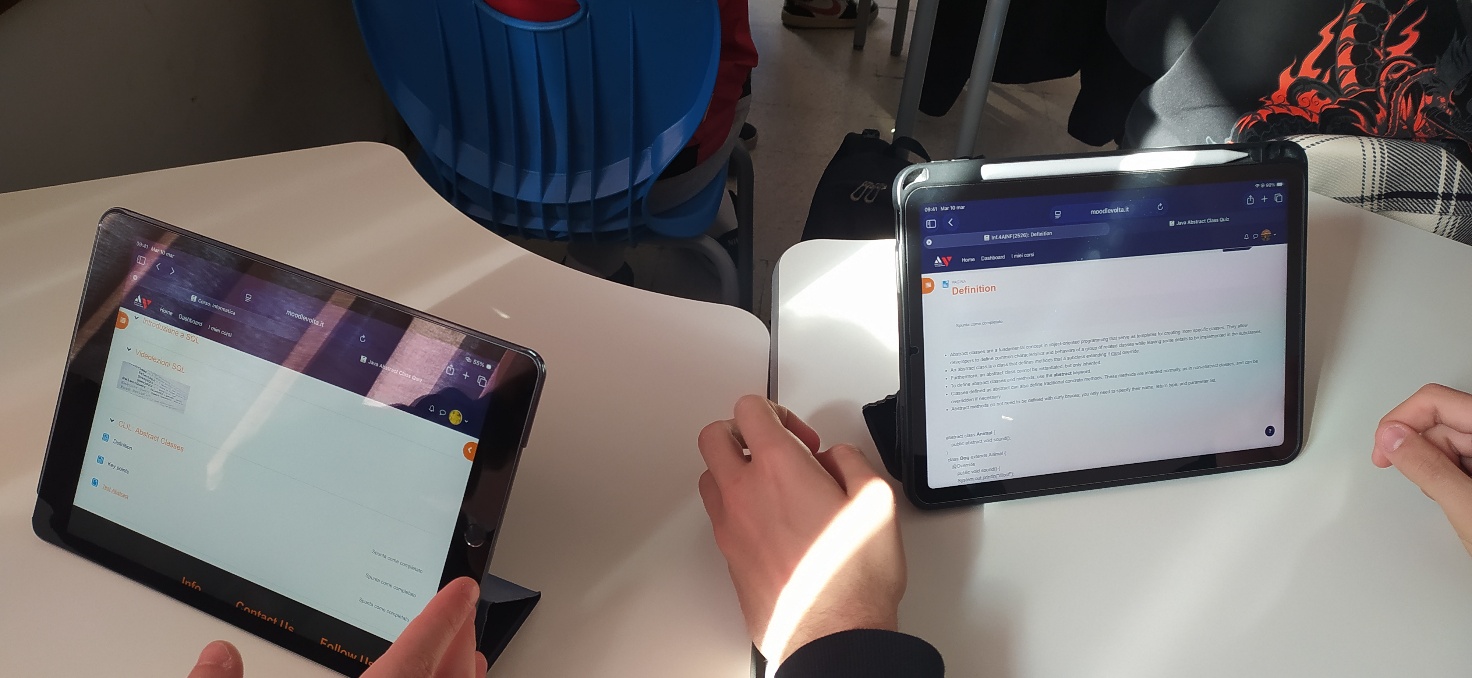
Nineteen students in class 4 AINF worked in groups on abstract class structures for a gaming application, banking system, e-commerce platform, transport system or scheduling application. They designed hierarchies, wrote Java code and prepared to present their solutions.
After the first session, some students needed more support with the English, the concept or both. The application generated a follow-up using familiar Animal and Vehicle examples. Instead of creating every class from a blank page, students extended provided abstract classes with concrete implementations.
The follow-up kept the programming concept intact and reduced the amount students had to process at once. It was useful across the class, not only for those who had initially struggled. Students then returned to the wider project with a clearer model of how the structure worked.
Ask for an access pathway
A useful request names the original objective and the barrier: 'Keep the requirement to understand and apply abstract classes. Create a familiar worked example with shorter instructions, define five essential terms and provide a partially completed structure that students must extend.'
The output must reconnect with the main task. The worked example should use the same relationship or process, and the final question should ask students to transfer what they have learned back to the original problem.
Before providing an alternative version
- State the subject concept or performance that cannot change.
- Identify the specific language or task demand causing difficulty.
- Choose one support that addresses that demand.
- Make the support available without labelling it as a lesser task.
- Plan how students will return to the common objective.
In the abstract-classes project, familiar Animal and Vehicle models gave students a route back into the same Java concept. The follow-up helped learners across the class, not only those first identified as struggling.