Text adaptation is often the first reason a subject teacher looks at AI. A dense source can be shortened, reorganised and rewritten at a more accessible level in seconds. That solves one part of the planning problem. It does not create a CLIL lesson on its own.
Students also need to meet the important terminology, understand what they are expected to do and use language for a subject purpose. A good sequence therefore moves beyond the adapted text. It prepares key language, gives students a task that requires content thinking and finishes with a clear product, decision or explanation.
A useful four-part sequence
A practical route is: adapt the source, prepare a small vocabulary set, build one structured task and add a short review. Each stage should serve the same subject goal. If students are learning about networks and netiquette, the language work should help them understand those ideas and communicate appropriately about them.
AI can reduce preparation time at each stage. Text Adapter can create a parallel version of a permitted source. The Lesson Creator can draft key terms, sentence frames, task instructions and assessment criteria. The teacher then decides what is accurate, necessary and realistic for the class.
Classroom example: networks and netiquette
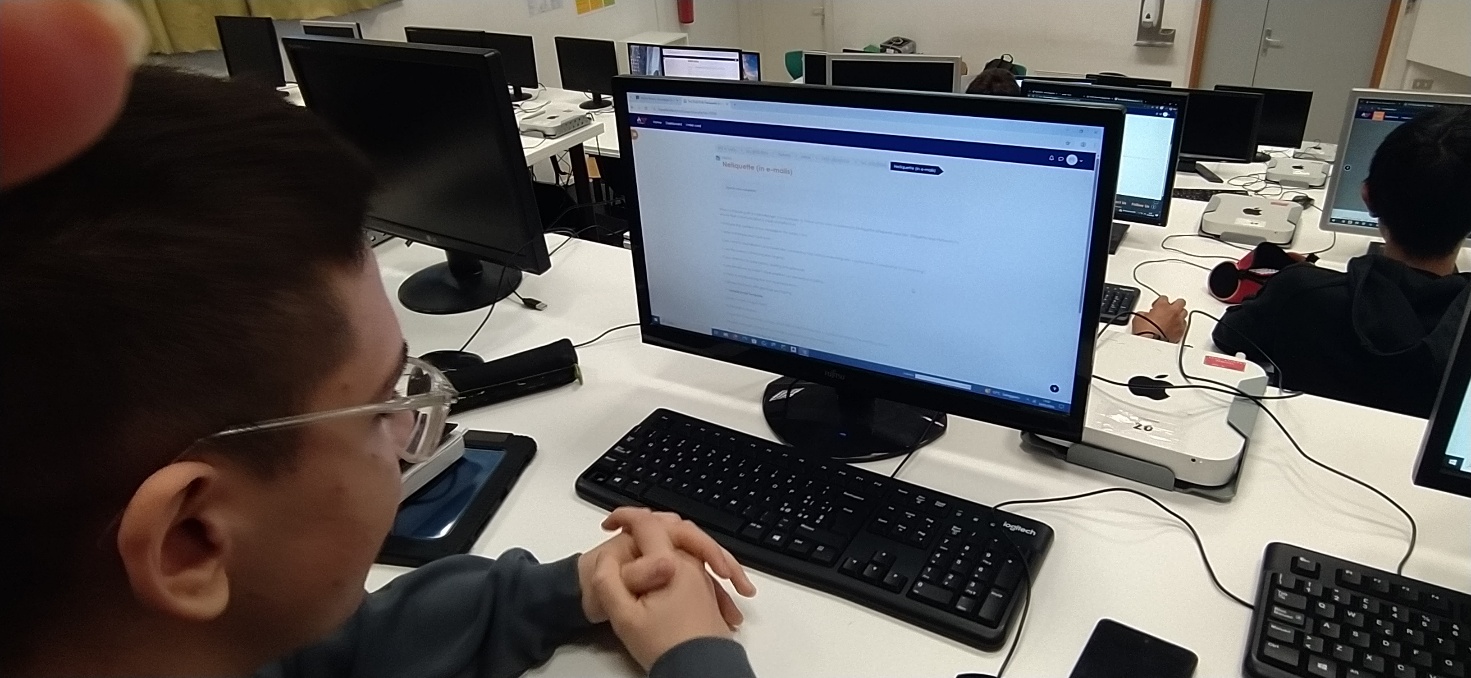
Laura Rosati used this sequence with ten students aged about 14 in class 1 EQ. It was their first structured work with technical English. The original network material was assessed at C1 and adapted to B1 with shorter sentences, clearer headings and simpler general vocabulary. The core computing content remained.
Before the main tasks, the class worked with a short set of terms including browsing, communication, resources and cloud storage. Read Aloud provided a pronunciation model, which the teacher checked before use. Students then completed a group network quest and moved to a netiquette email task.
Pairs wrote one appropriate email and one email containing deliberate mistakes. They exchanged the texts and used an eight-rule checklist for peer feedback. The task required students to apply the topic in realistic scenarios such as requesting time off, following up on an application or organising group work. The adapted source prepared them, but the learning became visible in what they wrote and explained.
What CLIL Notebook can draft
AI is useful for producing the first version of several connected supports. It can identify possible key vocabulary, reduce unnecessary language density, suggest sentence frames and turn a topic into a draft communication task. This is especially helpful when a teacher knows the subject well but needs time to make the language demands explicit.
The teacher still has to make the sequence coherent. A generated vocabulary list may be too long. Synthetic speech may mispronounce a technical term. A writing scenario may not suit the students. The output becomes useful when the teacher removes what is unnecessary and checks that every element points towards the same learning goal.
A planning check for teachers
- What must students understand by the end of the lesson?
- Which six to eight words are essential for that understanding?
- What language do students need to ask, explain, compare or justify?
- What will students produce or do with the content?
- How will I check both subject understanding and effective communication?
In the networks case, Laura Rosati combined a B1 text with a limited vocabulary set, Read Aloud, a group exploration task and a netiquette email. Each support returned students to the same technical content.