When a text is too difficult, the usual response is to replace it with an easier one. In CLIL, it can be more useful to keep both. A parallel text activity gives students access to the content and asks them to examine the language that changes difficulty.
This works particularly well with short technical explanations. Students can compare sentence length, general vocabulary, specialist terms and the amount of explanation. They become active readers of subject language rather than passive recipients of a simplified handout.
Why comparison matters
An adapted text can hide useful information from the teacher. If students only receive the easier version, it is difficult to know whether they struggled with one technical term, a compressed sentence or the overall topic. With two versions, students can identify the exact point where understanding improves or breaks down.
The original also retains the vocabulary students may meet in textbooks, examinations or professional settings. The accessible version can act as a bridge, while the source remains available for precision and further study.
Classroom example: jQuery
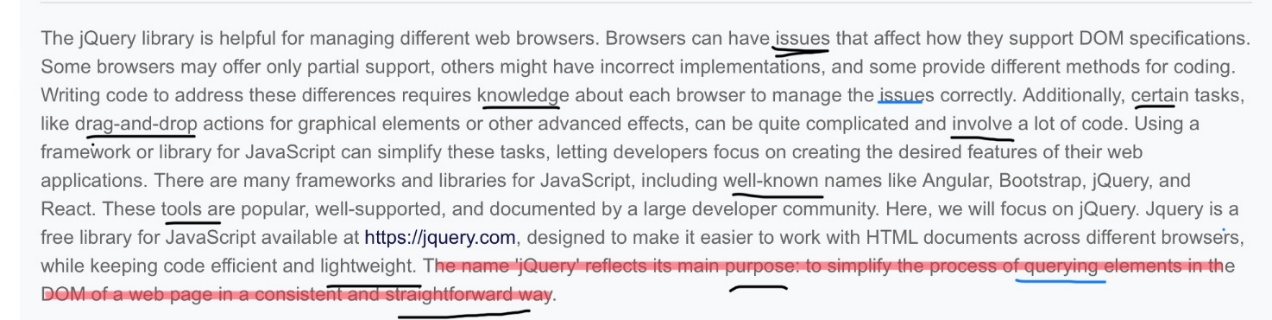
In class 4 AINF, 19 students worked with a short explanation of jQuery and web programming. It was the first time their teacher had used an English subject text with the class, and some students were anxious. She deliberately chose a manageable source rather than a long chapter.
Text Adapter produced a B1 version of the B2 text. Students read both and marked unknown words and difficult phrases. Their annotations identified querying, DOM, lightweight and straightforward as barriers in the B2 version. Some words in the B1 text, including dragging and features, also caused difficulty.
Students described the B1 version as more direct and less intimidating. More importantly, they could explain why. One student noticed that mistakes was easier than issues. Another valued the added explanations. The teacher left with a precise vocabulary record for future teaching.
Prepare two versions for comparison
AI can create the second version quickly and can explain the changes it has made in vocabulary, grammar and organisation. The teacher should request that essential technical terms remain unchanged and ask the system to flag any idea that may have been reduced or omitted.
The comparison should still be checked before class. A simpler synonym may be inaccurate in the subject. A shorter sentence may remove a condition. An unfamiliar technical term may need explanation rather than replacement. The teacher decides which differences are productive for students to examine.
A 25-minute parallel-text activity
- Give students a short original and one checked adapted version.
- Ask them to underline technical terms in one colour and difficult general language in another.
- Have pairs select three changes that improve access and one change they question.
- Discuss whether each difficulty comes from the subject, the English or missing background knowledge.
- Finish by agreeing a small vocabulary set for the next task.
In the jQuery case, students described the B1 version as more direct, compact and less intimidating. Keeping the B2 text beside it made the language changes available for discussion.